|
|
Bactria: pre-Seleucid
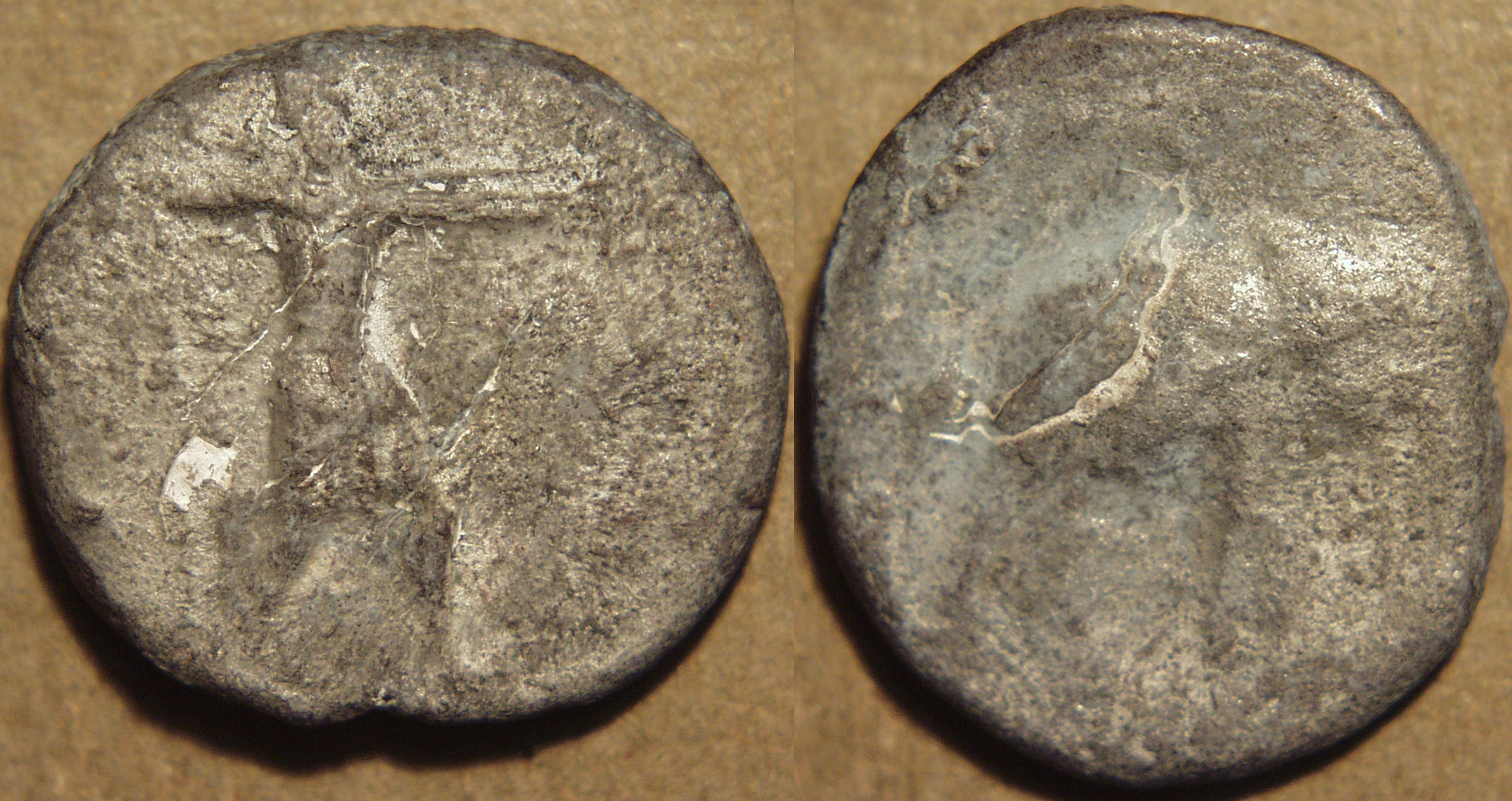
Alexander the Great ?
Silver Tetradrachm or Di-shekel, c. 328 BCE
Weight:10.85 gm., Diam:22-25 mm., Die axis:3h
Alexander ? standing right in Persian dress,
with Indian long-bow/ Elephant right
Ref: MIG 22 |
|
Mitchiner has argued that this extremely rare coin was minted by Alexander when he was headquartered in Bactria during
329-327 BCE. It was at this time he had adopted Persian dress. The elephant may refer to the defeated Persians (who had elephants in their army) or to India. But the Indian
long-bow points more surely to an Indian connection. Thus this coin may have celebrated Alexander's victory over Porus. |
|
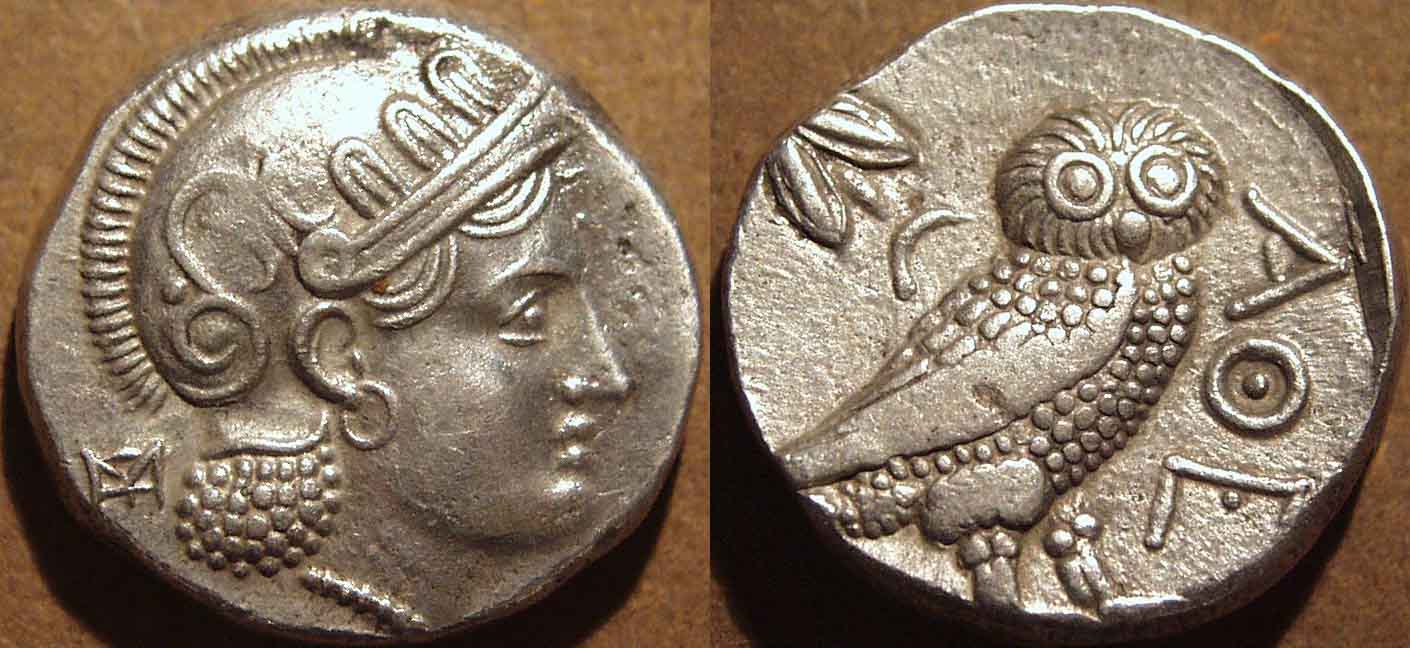
Bactria: pre-Seleucid
Imitation of Athenian "owl"
Silver Tetradrachm, c. 320 BCE
Weight:16.95 gm., Diam:23 mm., Die axis:6h
Bust of Athena facing right/
Owl standing right, crescent & olive sprig behind
Greek legend: AΘE (representing Athens) |
|
This coin, minted in Bactria, imitates the most widely circulated coin of antiquity: the Athenian "owl," which was copied in
many different countries. Numismatists disagree whether this coin was issued before or after Alexander's foray into India. Considering the wide variety of styles and artistic qualities
in which this coin is found, we feel it was quite possible that the coins were issued both before and after Alexander's presence in Bactria. This coin bears a monogram that was
used later by the Seleucids, and therefore may well have been issued by Seleucos I to pay his troops during the period from 323 to 312 BCE, when he was struggling to consolidate
his power. |
|
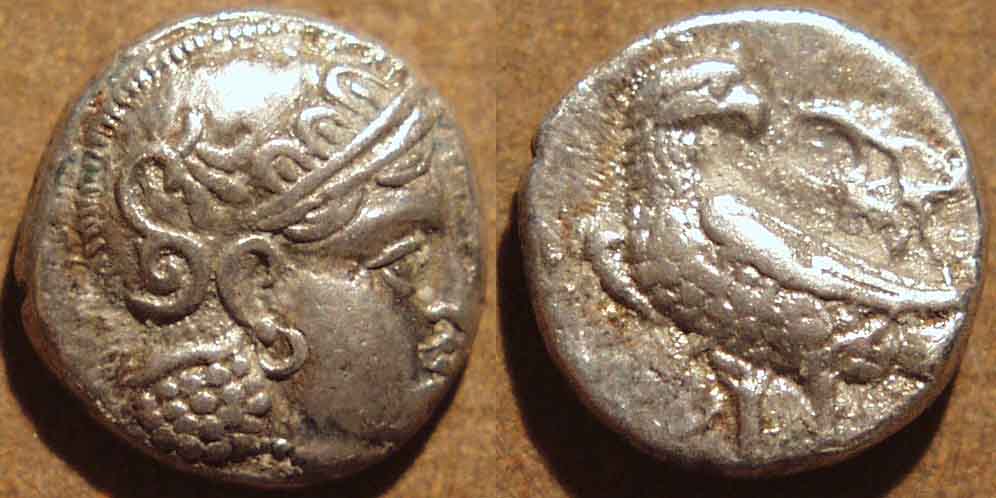
Bactria: Pre-Seleucid
"Eagle" series
Silver hemidrachm, c. 315 BCE
Weight:1.74 gm., Diam:11-12 mm., Die axis:6h
Bust of Athena facing right/
Eagle standing left, bunch of grapes above |
|
Note how the treatment of Athena in the "eagle" series closely parallels the rendition in the owl series above. |
|
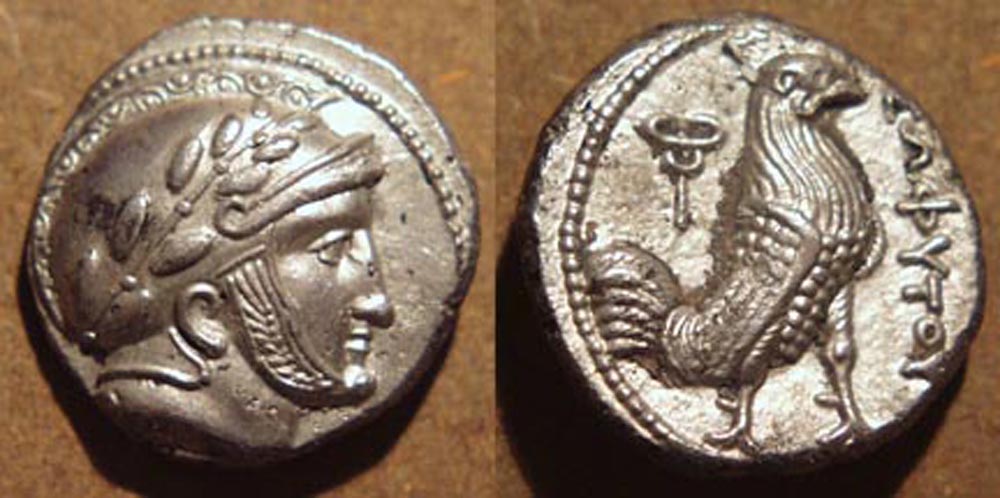
Bactria: pre-Seleucid
Sophytes
Silver Drachm, late 4th century BCE
Weight:3.79 gm., Diam:14 mm., Die axis:6h
Helmeted bust of Sophytes facing right/
Cock standing right, cadeucus behind
Greek legend: ΣΩΦYTOY (of Sophytes) |
|
Nobody knows who Sophytes was. Cunningham thought he was the Indian prince Sopeithes; others think he was a
Persian starap. Whoever he was, he certainly had a master celator in his service, as evidenced by this masterpiece of a coin. |
|
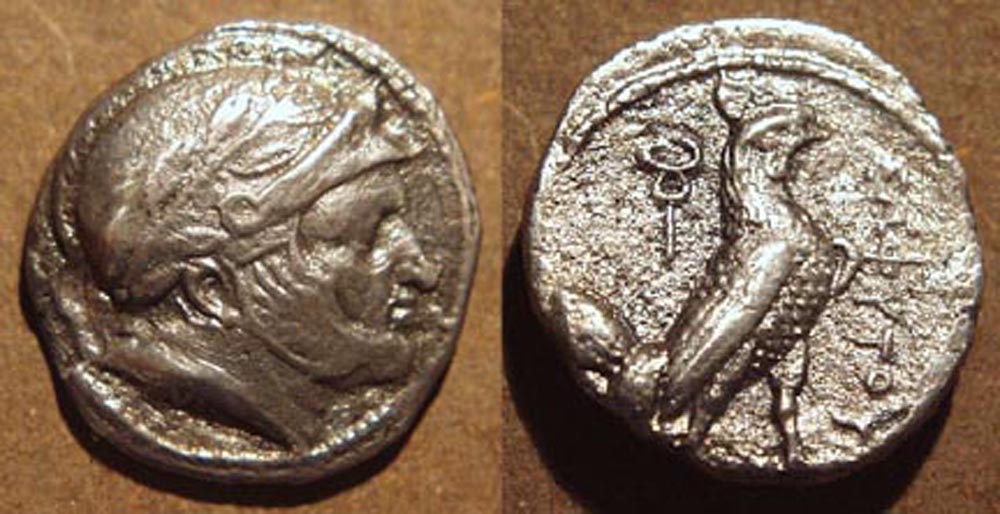
Bactria: pre-Seleucid
Sophytes
Silver Drachm, late 4th century BCE
Weight:3.41 gm., Diam:16 mm., Die axis:6h
Helmeted bust of Sophytes facing right/
Cock standing right, cadeucus behind
Greek legend: ΣΩΦYTOY (of Sophytes) |
|
If the portraits are life-like, which they probably are, Sophytes must have ruled for some time, as the older portrait here
contrasts with the much younger man shown in the previous specimen. |
|
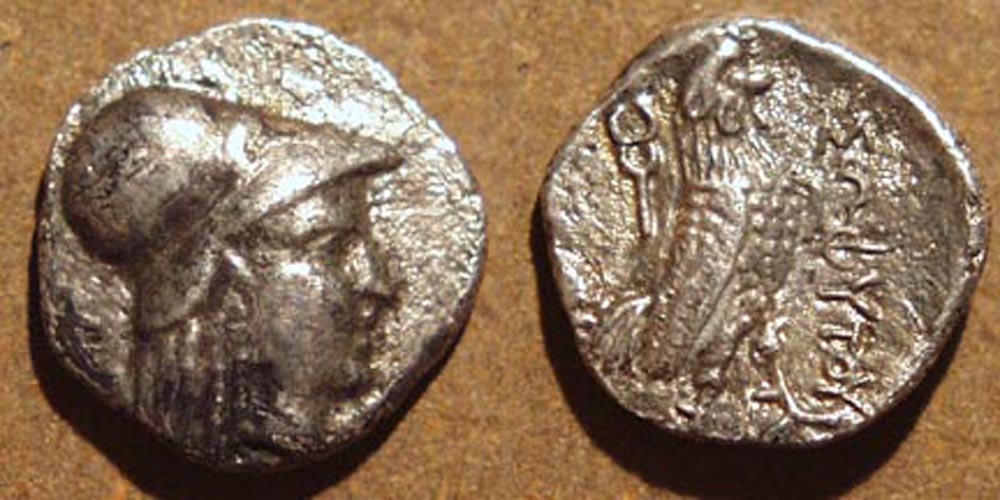
Bactria: pre-Seleucid
Sophytes
Silver Diobol, late 4th century BCE
Weight:0.95 gm., Diam:11 mm., Die axis:6h
Helmeted bust of Athena facing right/
Cock standing right, cadeucus behind
Greek legend: ΣΩΦYTOY (of Sophytes) |
|
In the tiny diobol, Sophytes elects to place the bust of Athena on the obverse, rather than his own. Note, though,
the Corinthian style helmet, and not the Athenian style we saw on the imitative owl coin above. |
|
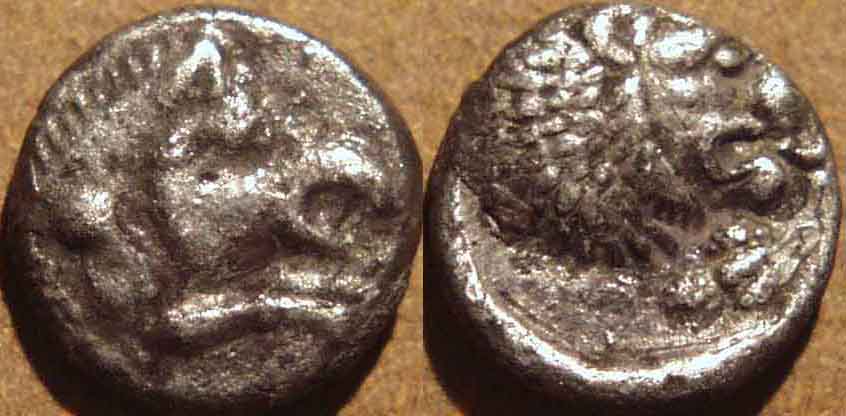
Bactria: pre-Seleucid
Anonymous
Silver Diobol, 4th century BCE
Weight:0.98 gm., Diam:9 mm., Die axis:10h
Forepart of a boar facing right/
Bust of lion facing right |
|
A specimen of this enigmatic coin was found in the excavations at Ai-Khanoum in northern Afghanistan. |
|
|
|
Coins from Arachosia |
|
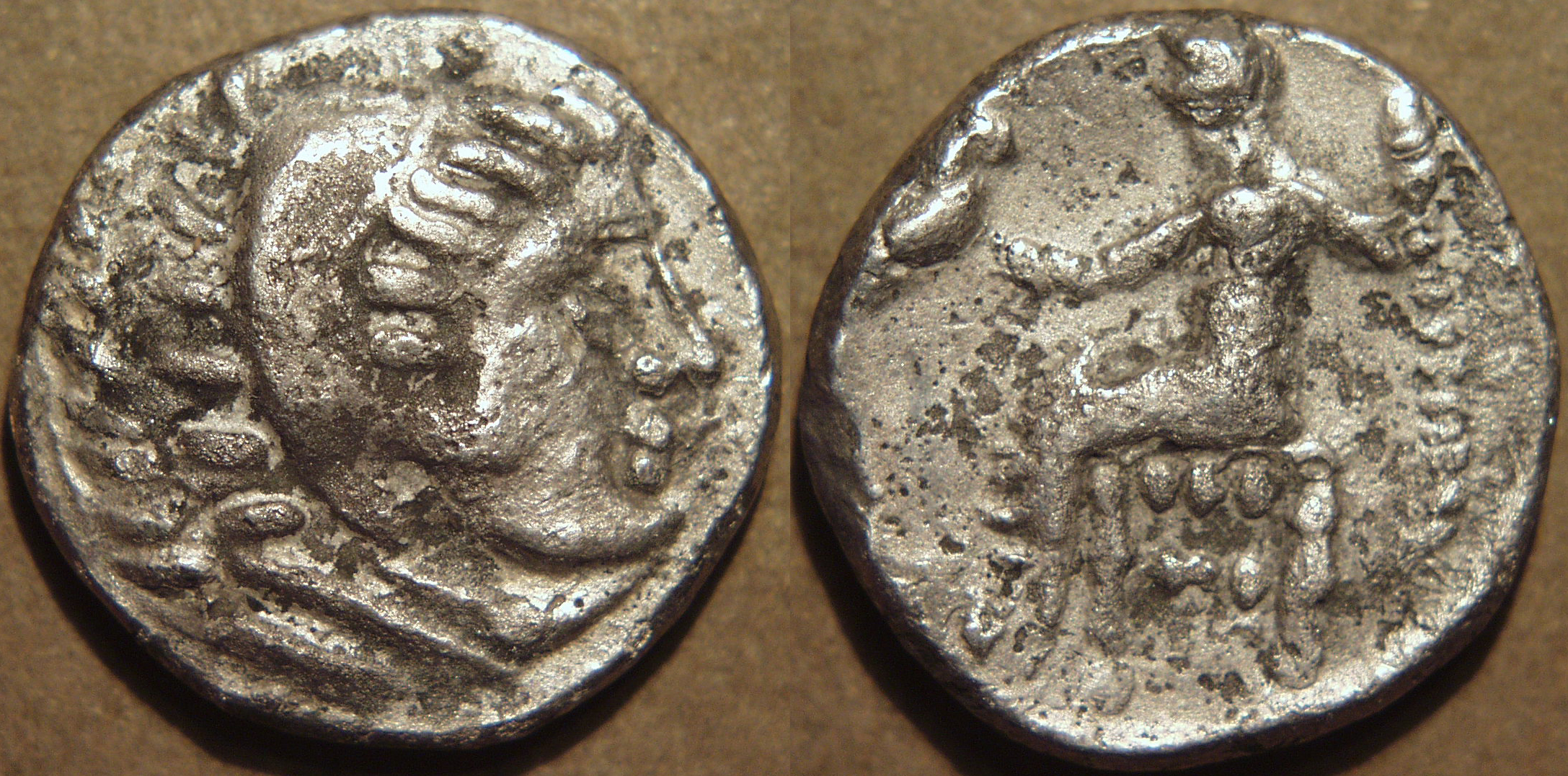
Arachosia
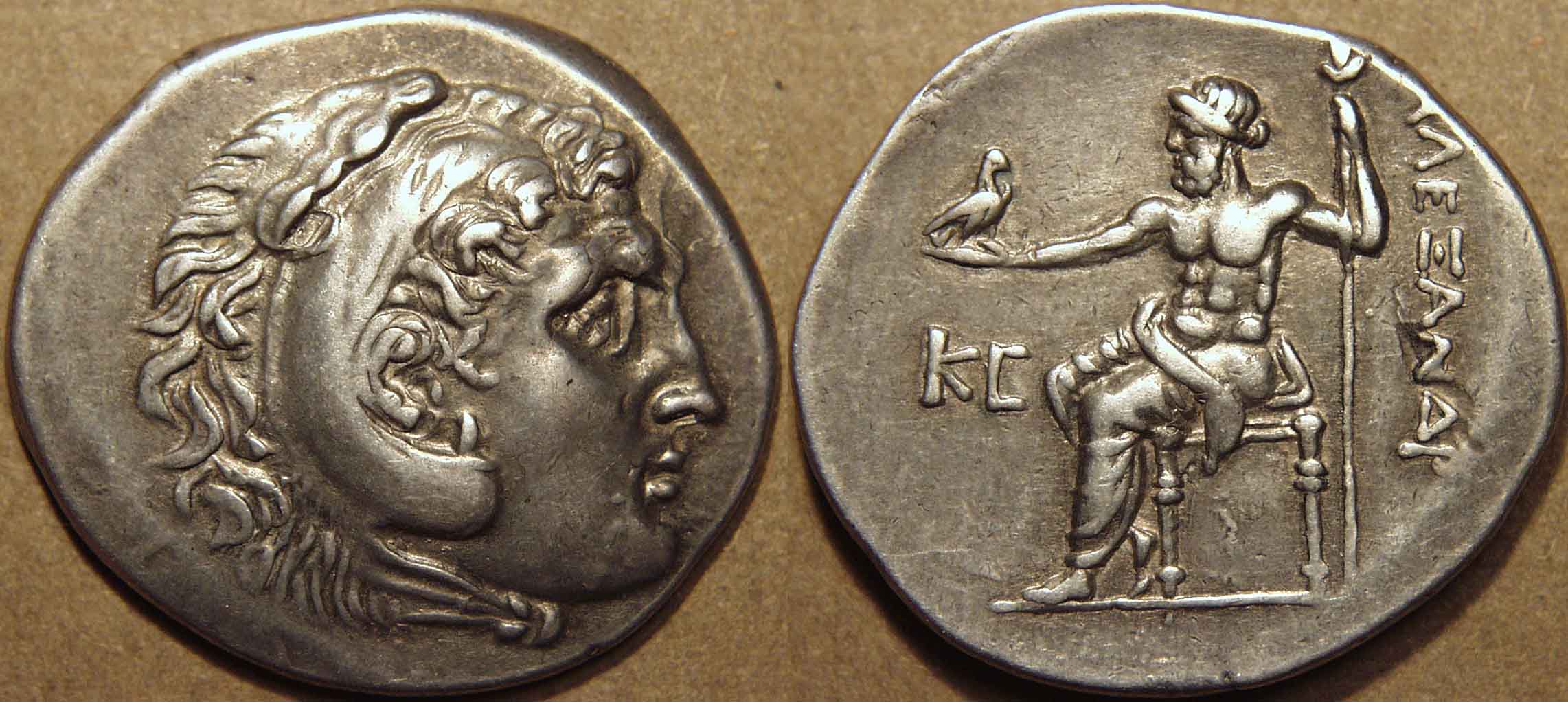
Imitation of Alexander III of Macedonia
Silver Tetradrachm, 4th-3rd century BCE
Weight:16.10 gm., Diam: 26 mm., Die axis:3h
Head of Herakles (Alexander ?) right, wearing lion head-dress, dotted border around/
Zeus enthroned left, holding eagle in outstretched right hand, scepter in left hand |
|
This coin and the next one appear to belong to a hoard of 200+ coins found near Quetta in 2001. The hoard was first discussed by
Houghton and Lorber in Seleucid Coins, Part I, pp. 483-486 and then published by Richard P. Miller: "East Arachosia (Quetta) Hoard, 2002" in Oliver D. Hoover, Andrew Meadows and Ute
Wartenberg-Kagan (eds.), Coin Hoards. Vol. X. Greek Hoards. Royal Numismatic Society-American Numismatic Society, New York, 2010. The hoard contained coins ranging in date from the late 4th
to the late 3rd century BCE, indicating that it had been buried perhaps in 206 BCE when the Seleucid king Antiochus III passed through the area on the way back from his expedition into
Bactria. About 30% of the coins in the hoard consisted of these very crude silver tetradrachms imitating the coins of Alexander the Great. Many of the Greek kingdoms in this period issued
coins of this type (for an example: see this), but these crude types issued in Eastern Arachosia (the Quetta area) were unknown until the discovery of
this hoard. This area had been ceded by the Seleucids to Chandragupta Maurya, but perhaps the apparatus of the Mauryan state did not pentrate it deeply enough and the need for
coinage may have been felt. Greek soldiers in the area would have been comfortable with coins that looked roughly like the ones they were used to, so it is quite likely that these coins
were issued primarily for circulation in Greek communities. This coin, while not published by Miller, appears to be struck from the same dies as Miller 145. (My thanks to Waleed Ziad for
bringing these coins to my attention, and for helpful discussions.) |
|
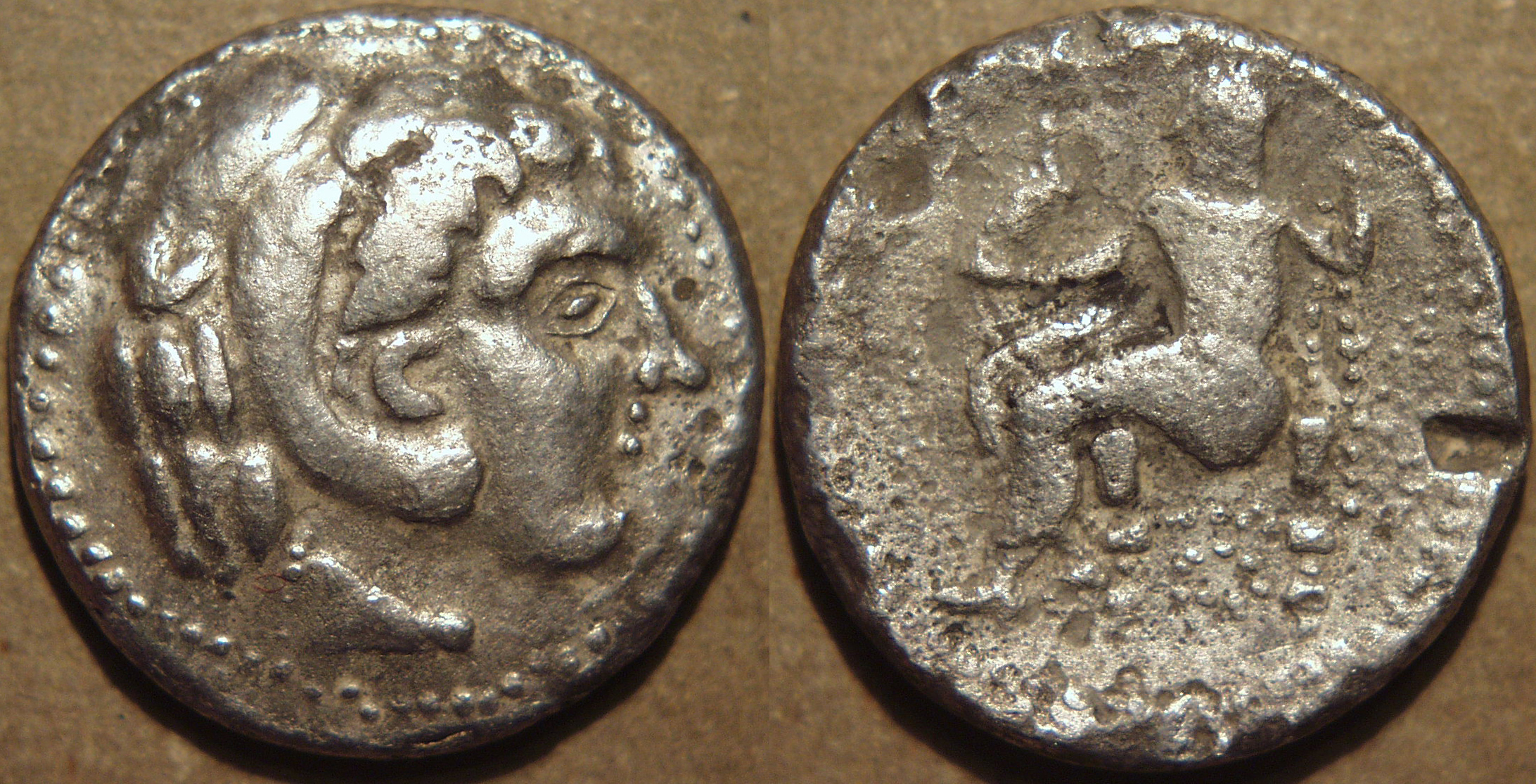
Arachosia
Imitation of Alexander III of Macedonia
Silver Tetradrachm, 4th-3rd century BCE
Weight:16.45 gm., Diam: 26 mm., Die axis:11:30h
Head of Herakles (Alexander ?) right, wearing lion head-dress, dotted border around/
Zeus enthroned left, holding eagle in outstretched right hand, scepter in left hand |
|
This coin has the characteristic "Indian" eye on the portrait of Herakles/Alexander, indicating the hand of an Indian celator. |
|